Chapter 6: The Long Ministry, 1906 - 1909: The Heyday of the Giolittian System
Key figures
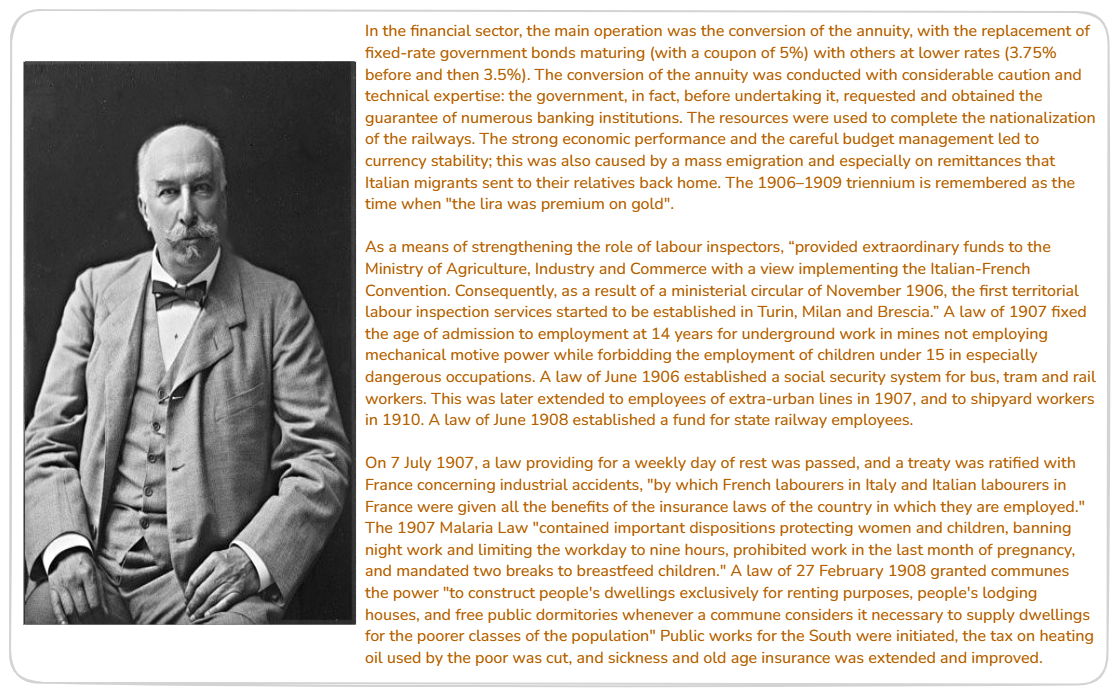
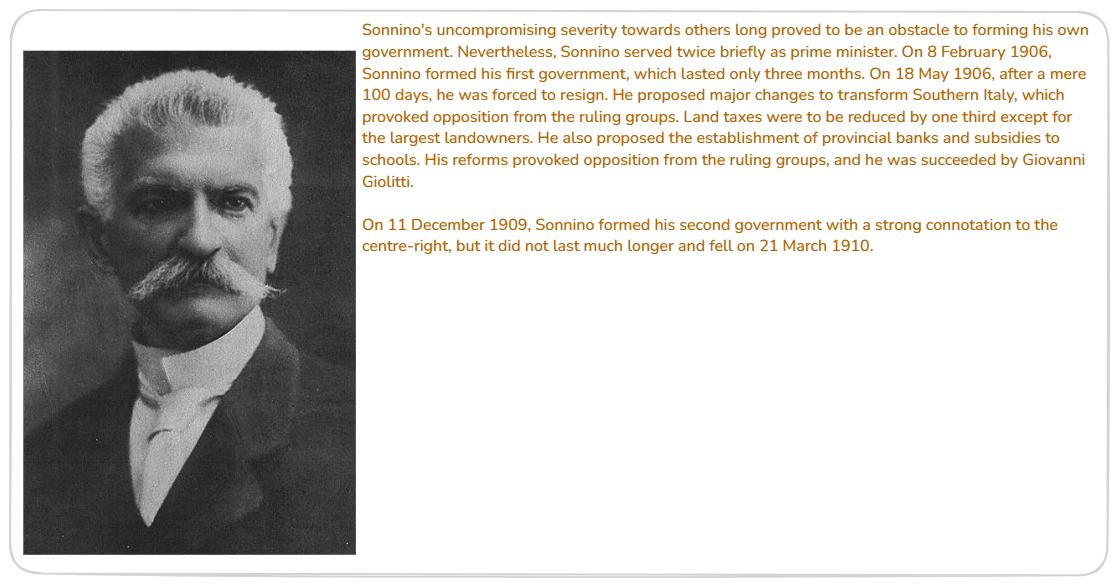
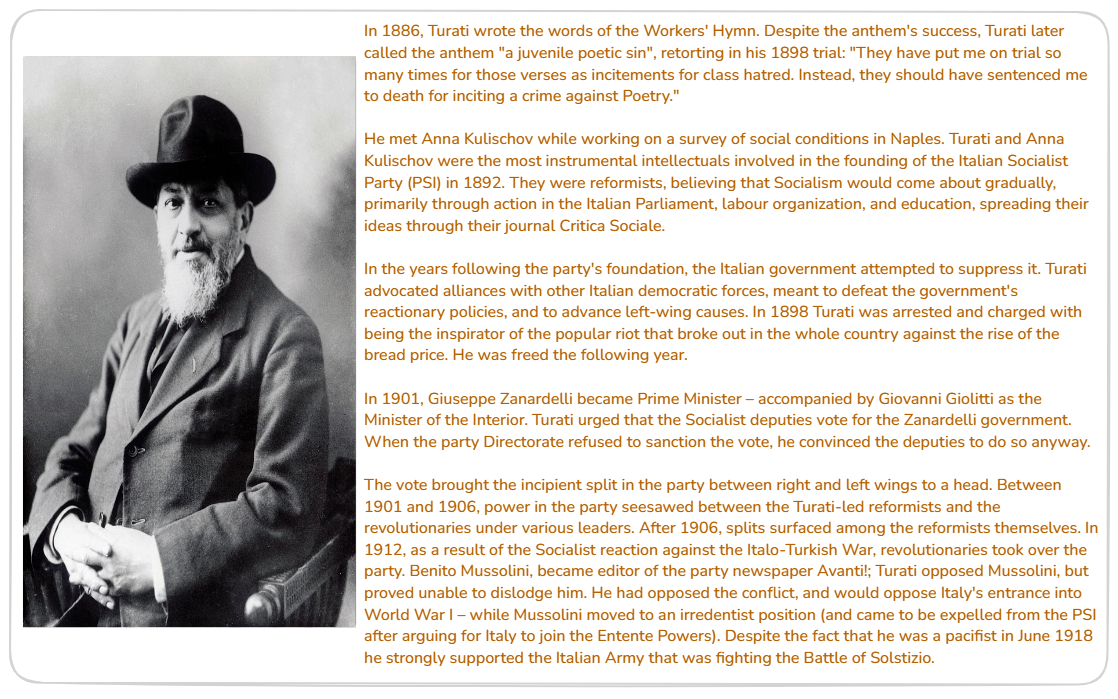
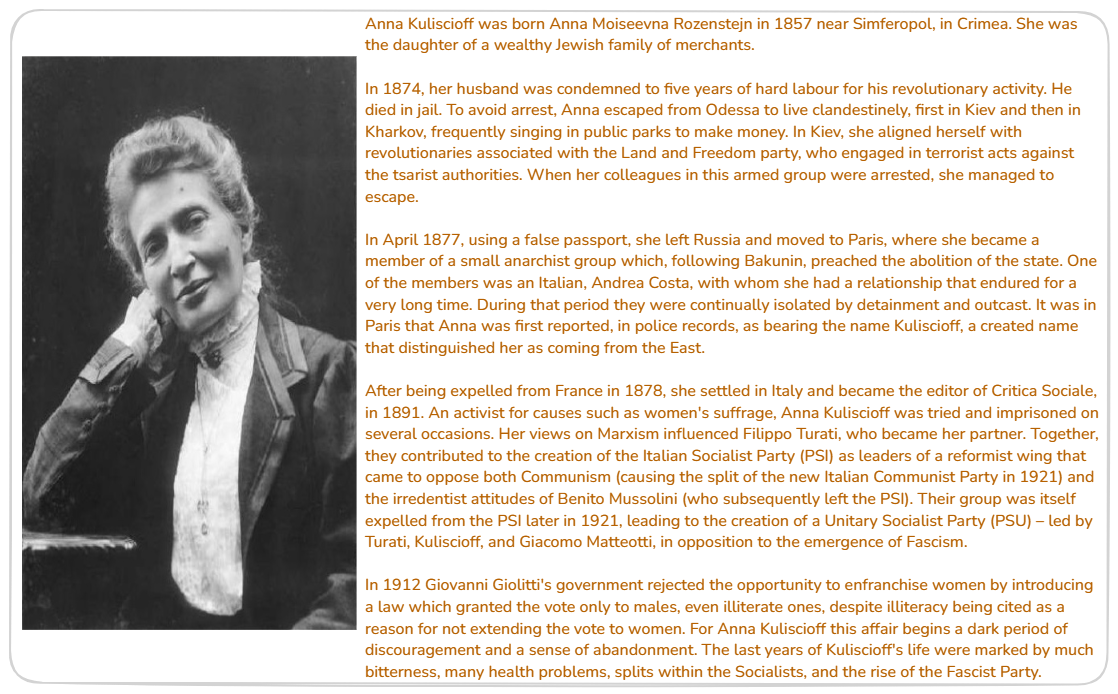
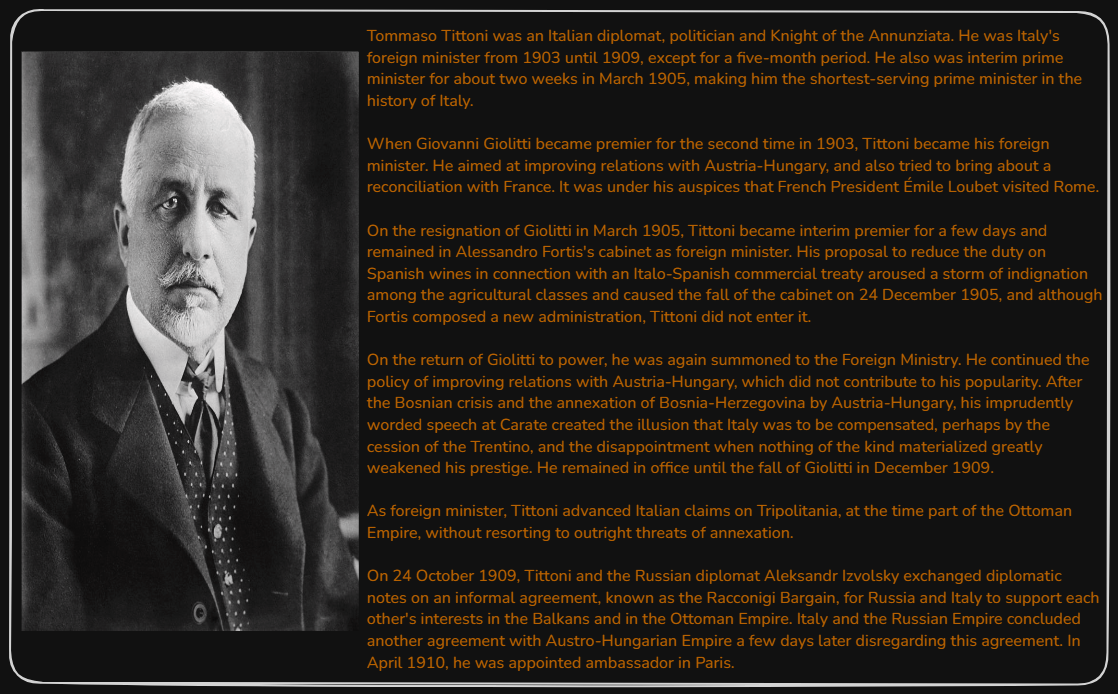
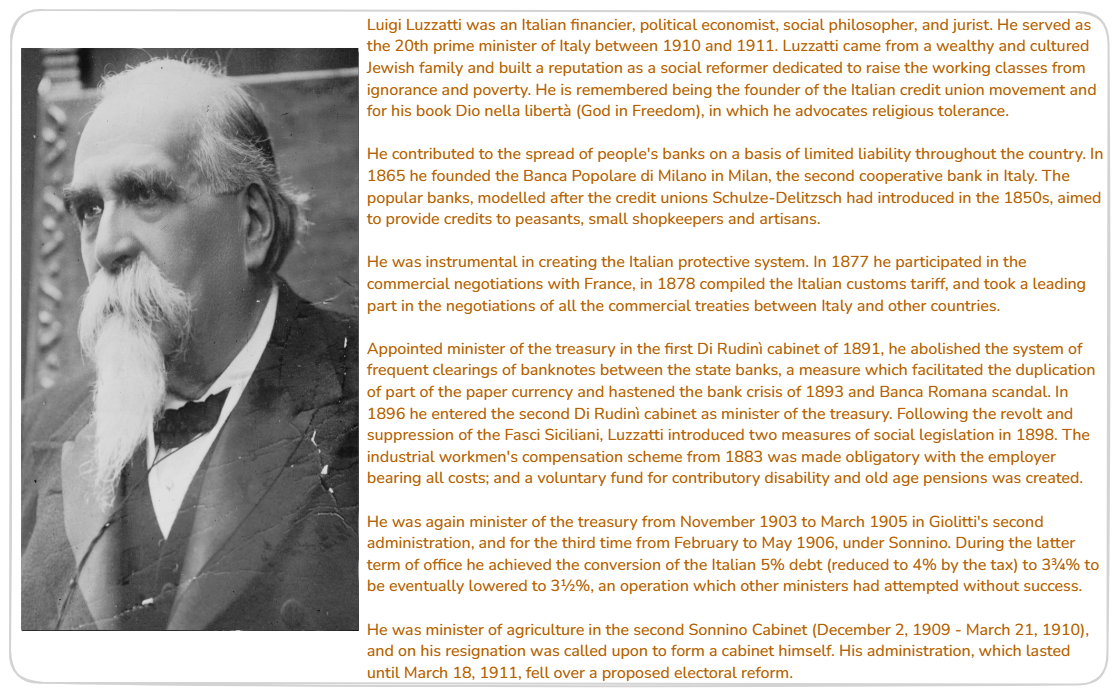
Building bridges to the right
Giolitti began his longest government somewhat reluctantly. Senator Tommaso Senise described what Giolitti and his closest advisers would have liked to clear up before regaining office: “Surely the crisis did not arrive on time; it has been downright impatient! We had to discuss and resolve first the railway question, that of the South and also the inquiry into the navy: and then wage open warfare! But events have been precipitated both by Sonnino—out of ineptitude—and the opposition out of impatience.” Despite everything, if Giolitti refused to take the presidency, the king would have no option but to go back to Sonnino and give him the right to call new elections: “And would you like to consign all your political friends to the sword of Hon. Sonnino?”¹¹
Giolitti had brought parts of both left and right within the framework of the new course between 1901 and 1905. Whether the conversion proved durable over the long term and whether the conciliation of both left and right was even possible or desirable remained unsettled. Certainly the 1906–1909 government consolidated earlier gains on the right. Giolitti continued to attract conservatives to his majority as long as he closed the door to the Estrema, but once he began to move leftward again in 1911, many conservatives deserted to follow not Sidney Sonnino, but Antonio Salandra. However, the political arithmetic in May 1906 was too clear to be ignored. The Chamber of Deputies that had been elected to punish the Socialists for the general strike in 1904 was naturally oriented to the right, making Giolitti’s return at the head of a conservative government almost a foregone conclusion.² In fact, the new government continued the 1903–1905 administration without Luigi Luzzatti. Tommaso Tittoni returned as foreign minister and clerical-conservative Emanuele Gianturco became minister of public works.³ Other conservatives followed them into the Giolittian majority. During the 1906 government Pietro Bertolini, Antonino di San Giuliano, Guido Fusinato, and the clerical Gianforte Suardi came on board, ==leaving the traditional leaders of the right in disarray.==⁴ Suardi explained Antonio di Rudinì’s increasing isolation:
You can want a Ghibelline Right but you cannot presume to be joined by those who for some time openly pursue a very different tactic that results in the present détente and that I have the honor to lead in my own city with the full accord of all parties. You can fight military expenditures but you cannot expect to be followed by those who approve the policy of economies in times of hardship but who believe, in the present financial conditions, that it is not only a political duty but also patriotic one to increase armaments. . . . As you see, my dear Cesare [Fani], it is not inconsistency; it is coherent and fundamental ideas that lead me to follow Tommaso [Tittoni], Giolitti and the others inasmuch as they agree with these ideas and seek to act on them.⁵
The leadership of the old conservative opposition was up for grabs. Rudinì had little taste for battle: “As for me, I’ll tell you that I halfheartedly lead our troops into fire. I do it out of duty because without us there would be no constitutional opposition.” Even Sonnino urged his followers to play for time and wait on events.⁶
Giolitti balanced this rightward move by including several former Zanardellians in the cabinet. Francesco Cocco-Ortu, a Sardinian and old friend of Zanardelli, returned to the Agriculture Ministry. Fausto Massimini, another Zanardellian, became finance minister, and Niccolò Gallo made his peace with Giolitti and joined the government as justice minister. He completed the process by winning over ex-crispini like Pietro Lacava and Camillo Finocchiaro-Aprile.⁷ Finally, Giolitti nurtured the careers of several younger leaders like Carlo Schanzer, a future foreign minister and senator, who was named minister of posts. Schanzer, a bureaucrat as Giolitti had been, made his way up the administrative ladder to the Council of State by the age of thirty-two. Giolitti then smoothed his way in the elections of 1904 in Pietro Rosano’s college of Aversa, where the notorious power broker Giuseppe Romano held sway.⁸
Social and economic policy
Giolitti offered no major social or economic reforms in his program for the new government. To continue shoring up his Southern base, he included measures for the Southern provinces as well as a commission to look into the peasant agitation in the South and on Sardinia, and, to please reformers, another commission to study naval procurement contracts. After the kind of listless debate that Giolitti preferred, the government won a vote of confidence, 262–98, with only the Socialists, the Radicals, and Sonnino’s conservatives voting against.⁹ Giolitti moved quickly on the railways. In June, Gianturco presented a bill to regulate rail services and the personnel. Giolitti and Gianturco got the buyout of the remaining private companies through parliament in July. ==By June 1907 a law for the creation of an autonomous agency to manage the state system was finally approved by parliament. Left unsettled were the problems of unionization on the state lines and the right to strike.==¹⁰ As the Chamber of Deputies debated the railway bill, it simultaneously took up the proposals for the South. Whereas Sonnino sought to redirect Southern agriculture toward more specialized crops and away from grain, Giolitti preferred smaller and more concrete reforms. Special laws for the South dealt with industrial and commercial development, local taxes, the assumption by the state of the costs of elementary education, and the reform of agrarian contracts, but stayed within the existing social and economic rural framework.¹¹
The completion of the debt conversion in 1906 gave the government some room for maneuver. Service payments on the debt dropped from 34.4 percent of state expenditures to 20.9 percent in 1912–1913.¹² Though Giolitti never viewed the budget savings as sufficient for major reforms, they were the precondition for some significant achievements. He cut the tax on heating oil used by the poor, reduced postal rates, nationalized the telephone service, expanded the Sicilian rail lines, initiated public works for the South, and enacted labor legislation: Sunday rest, expansion of old age and pension funds, and limits on female and child labor. As an indication of this new emphasis on infrastructure, the budget for the Ministry of Agriculture increased from 13 to 27 million lire, that of the Ministry of Public Works from 79 to 117 million, that of the Ministry of Posts from 68 to 123 million, and that of the Ministry of Public Instruction from 49 to 85 million (of which 15 million lire went to elementary schooling).¹³
These laws, though often laudable, were passed in a manner that left the Socialists out of the legislative loop. The law protecting rice workers typified the vision behind Giolitti’s social legislation. In 1904 Giolitti had argued that special protection for the rice workers was unnecessary, but in 1907 he defended the bill “if one wishes to provide for the education of our working classes, to introduce gradually the two principles of the labor contract and arbitration.” Giolitti considered labor organization to be an effective way of educating workers, controlling violence, and arriving at compromise. The major gain for the Socialists was that the principle of the labor contract would be extended to agriculture and formally endorsed by parliament. But when Filippo Turati tried to turn the conciliation process into real arbitration, Giolitti promised to consider it in the future; for the moment, conciliation was enough.¹⁴
Unionisation and state workers
Growth in all levels of government bureaucracy took place during Giolitti’s third ministry, in part because of the nationalization of basic services but also because Giolitti and Postal Minister Schanzer favored administrative solutions to problems. As Schanzer put it during a 1907 debate over nationalization of the telephone service, the government did not take over the telephone service for financial reasons but, rather, “for political and administrative reasons”; ==only the state could ensure that the lines would be extended to all parts of the country, especially to the South.==¹⁵
The expansion of the state into areas like rails and telephones meant the incorporation of large numbers of workers who were not typical civil servants. From 1891 to 1910, state employees increased from 126,343 to 376,777. Public sector workers on all levels were organizing rapidly. During the first decade of the twentieth century, the associations of state employees grew to 132,000 members. The postal and rail unions had 15,000 and 10,000 members, respectively. Postal workers began to organize in 1902; then, under the leadership of Antonino Campanozzi, the Federazione Nazionale Postale Telegrafica merged in 1906 with the Società Nazionale fra Ricevitori Postali-Telegrafici to form a powerful and unified labor union. Around 1900 the several organizations of railway workers allied for the strike agitation of 1902 and again in 1904. In 1901 and 1902 two teachers’ unions, the Unione Magistrale Italiana and the Federazione Nazionale Insegnanti Scuola Media, were created. The Federazione Nazionale d’Impiegati held its first congress at Naples in 1904.¹⁶
Giolitti’s hostility toward unionization of state employees meant conflict with the reformist Turati, who served as adviser to several of the state employee unions and whose conception of the state bureaucracy as a democratizing force contrasted with Giolitti’s view of the bureaucracy purely as an instrument of state power. In June 1907, Giolitti rejected proposals to set up a commission to examine the status of civil servants: “I do not consider it possible to defer to a parliamentary commission of whatever size a task that is essentially that of the government.”¹⁷
Giolitti’s determination to settle the issue of civil service organization increased after the strike wave of autumn 1907. In 1907 there were 2,258 strikes involving 575,930 workers. The recession of that year also marked the end of the boom that began 1898. The immediate crisis came in the fall of 1907 at Torremaggiore in Puglia. The local peasant league had been engaged in a long battle with the landowners. On November 2, after the peasants blocked the roads, the police fired, killing a young pregnant woman. Justice Minister Vittorio Emanuele Orlando and Giolitti sent Public Security reinforcements to Bari and advice to the prefect on criminal statutes that might be used against the strikers.¹⁸ When the courts ordered the release of the secretary of the Camera del Lavoro of Bari, who had been arrested in the effort to break the Pugliese peasant leagues, and then sentenced those engaged in the Torremaggiore strike to only a month in jail, an outraged Giolitti accused the court of using right-to-work statutes instead of the criminal ones in handing out light sentences. He cited this as justification for maintaining iron discipline in the state bureaucracy, because restoration of order could not succeed unless it were seconded by “an energetic action of the judicial authority.” He cautioned Orlando “to ensure that the indulgence that seems to guide the action of the judges in that province does not give greater encouragement to the agitators.”¹⁹
Strikes at the Terni steel works and at the rail yards in Ferrara, Milan, and Turin soon followed in October 1907. Rejecting appeals of the reformists in parliament, Giolitti supported the railway administration, which suspended the strikers in Milan and Turin. He moved quickly to take advantage of the disarray within the labor movement. The revolutionary syndicalist unions that had called the general strike in October needed the support of the reformist-led General Confederation of Labor (CGL), but the labor confederation did not relish another losing confrontation with the government. The crackdown continued into 1908. Alceste De Ambris, the fiery syndicalist leader in Parma, called a general strike in May 1908 that led to the temporary dissolution by the government of the local Chamber of Labor. Ever the realist, Giolitti understood that the peasants were too weak to hold out: “The strikers must reflect that it is not easy to transfer elsewhere and find work.”²⁰ In June, Giolitti wrote to Orlando, requesting that the police and judicial authorities work together to see if the head of the provincial Socialist confederation of Mantua should be investigated for violations of the penal code. Revealing the extensive coordination between the executive and judiciary, Orlando moved quickly, even to the point of writing to the prosecutor of Brescia, asking if a newspaper in that city could be prosecuted for the publication of a manifesto urging the use of the boycott.²¹
Responding to an inquiry about his handling of strikes, Giolitti noted that unfortunately workers were “in many places no longer in the hands of the reformists. They have fallen . . . in the hands of revolutionary elements who seek to redirect, to remove the purely economic character from the struggles between capital and labor, and to give them a political character.” The remedy was to increase the involvement of the unions through voluntary arbitration, cooperatives, and municipal reforms.²²
The struggle over personnel policy
On December 9, 1907, Giolitti presented to the Chamber of Deputies a draft law on the legal status of the state workers that set up categories of state workers, examinations for admission, disciplinary norms, and procedures for dismissal. The Socialist General Confederation of Labor and the parliamentary Socialists naturally fought provisions that gave the authorities new weapons to dismiss strikers or obstructionists.²³ Giolitti defended the law as the necessary minimum “because, even our friends of that part of the Chamber [the left] admit that no government, however liberal, however advanced, will function if the public services are disorganized. Now, the organization of the public services demands out of absolute necessity a hierarchical dependence. If there is someone who executes, there must be one who commands and he must be certain that he is obeyed.”²⁴ On the right to strike, Giolitti stated bluntly: “Let the state employee who wishes to rebel, resign and then do what he wishes. But as long as he continues to have in hand the exercise of public power, he is a traitor if he puts himself politically against the state.” When a frustrated Turati asked if this covered those who cleaned the latrines, Giolitti answered that all public services were vital.²⁵
In fact, Giolitti promptly used the law in December 1908 to dismiss postal union leader Antonino Campanozzi for accusing the government, in a speech to his union congress, of making a deal with Pirelli for underground cables at inflated prices. The government acted under the provisions that forbade the release of official information. Giolitti’s response to Turati again revealed their fundamental differences: “It is well that you understand that discipline will be maintained rigidly; that the government absolutely does not want these associations, of which I now speak and which we respect, to become a weapon against the state and to become above all a means of blackmailing superiors. This we will never permit.” As Guido Melis, the historian of the Italian bureaucracy, put it, ==Giolitti made the state apparatus more efficient and rational, but not necessarily more democratic.==²⁶
Increasingly frustrated, the reformists tried to move beyond the limited reforms offered them. At the Socialist Party’s 1908 Florence congress they united on a program of “great reforms” that, if enacted, would have changed the liberal state in fundamental ways: universal suffrage for both men and women, payment of deputies, school reform, progressive taxation, free trade, and the nationalization of public services. In Turati’s scheme of things, each reform should move Italy toward greater democracy and undermine Giolitti’s purely administrative liberalism. None of these great reforms, especially enlargement of the franchise, had figured in Giolitti’s 1906 government program. He rejected out of hand the two most political planks in the Socialist “great reforms” program: payment of deputies and enlargement of the suffrage. Giolitti tied the vote for women, as he did the other issues of mass participation, to the evolution of Italy, which was still unprepared for such a move. A year later he vetoed a Socialist move to pay deputies. On the vote for illiterates, Giolitti stated his position as bluntly as possible: “I do not consider calling the ignorant masses to judge the great interests of the country to be progress.”²⁷
Nor did Giolitti’s stand change when the Radicals and Socialists added the suffrage question to the programs for the elections of 1909. When the Republican Roberto Mirabelli, a longtime supporter of expanding the franchise, moved the issue once again, Giolitti responded: “He knows my opinion. I believe that we should arrive at universal suffrage by this road—teaching everyone to read and write—so that everyone will acquire the right to vote. But I do not believe that giving the voting to illiterates would be progress.” As for another request of the Estrema, Giolitti argued that proportional representation would also be a mistake in a country with an ill-developed party structure like Italy: “Parties will come in the future, but today it does not seem to me that we are in this condition. And I contend that to cut off the contact between elector and elected would not certainly be progress.”²⁸
Anticlericalism and the popular blocs
The convergence between Radicals and reformist Socialists to push for suffrage reform and to meet the growing political power of Catholics led to the formation of popular blocs. The years from 1904 to 1907 had seen a notable gain in Catholic political organization. In 1906 the Unione Elettorale Cattolica Italiana was created to prepare for the full removal of the ban (non expedit) on Catholic participation in national elections.²⁹ Radicals and Republicans, whose secular ideology made them hostile to the Catholic Church, reacted immediately. The Socialists, much less wedded to the traditional anticlericalism of bourgeois Italy, mobilized after open appeals by Catholics for an anti-Socialist front with the liberals and the partial lifting of the non expedit in 1904. The example of France, where the Radical anticlerical Georges Clemenceau took power in 1906 with French Socialist backing, led some Italian Socialists to envisage a similar alliance.
In Catholic Lombardy and the Veneto, Radicals and Socialists were under great pressure from resurgent clericals, often in alliance with conservatives. Consequently, Brescia (Zanardelli’s former base), Cremona, and the other cities of the upper Po Valley where clerical strength was growing saw the first signs of a counteralliance of the popular parties; victories of these blocs in local elections in Rome and Florence seemed to confirm the strategy.³⁰ After May 1906 the three parties of the Estrema found themselves outside of the Giolittian majority, alienated by the presence of Tittoni and other clericals in the government, and often united by common membership in Freemasonic organizations. The middle-class Masons themselves became more acceptable to reformist Socialists as the Grand Orient Lodge moved leftward in 1906. The resurgence of the reformists within the Socialist Party after the failure of the revolutionary strikes of 1907 was the final step.³¹
The battle over religion in the public schools
The battleground in 1907 and 1908 was the schools. Pressure had been growing for the state to take over primary schooling. Reformers like Gaetano Salvemini argued that it would be a step toward real change only if a wall existed between the schools and religious instruction. A regulation of 1895 stated that communal governments had to offer catechism classes at parental request. When Leonida Bissolati raised the issue in 1904, Public Instruction Minister Orlando interpreted the regulation as giving the communes the right to reject the request. In 1907 Catholics pressed to return to the original reading of the 1895 regulation. Giolitti tried to finesse the entire issue by denying that the government had any role at all in defining religious policy, except “to declare itself incompetent. . . . I do not know why the government must have an ecclesiastical policy; I believe on the contrary, that the duty of the government is to force all citizens, whatever their role or their dress, to obey the law. . . . Citizens must be free to profess the religion in which they believe and in the best way they want, provided that they do not violate the law.”³² Giolitti pushed the issue down to the local level, which provoked a strong protest from Public Works Minister Gianturco, who threatened resignation over Giolitti’s decision to give to “unstable majorities, sometimes clerical, sometimes Socialist, on the communal councils the right to decide a question that has always and everywhere been within the competence of the Parliament or put in the free judgment of fathers of families.”³³
When Giolitti simultaneously allowed the cardinal of Lucca to be buried with full military honors, the Republican Salvatore Barzilai had enough, but Giolitti countered that the honor was for the people of Lucca, who requested it. The incident would have been minor but for the fact that it elicited from Giolitti a restatement of his most famous expression on church-state matters: ==“My thesis has always been the following: the church and the state are two parallels that must never meet; the one does not need the support of the other.”³⁴ ==Of course, Giolitti’s actual policies were hard to reconcile with these general statements of principle. He sought Catholic votes in the province of Cuneo and had no intention of renouncing the authority of the state to regulate religious matters. But he used the image of the two parallels to relegate religion to a sphere of private life. His position exactly matched the consensus within the liberal group.³⁵
Catholics mounted a petition drive throughout Italy for a reinterpretation of the 1895 regulation. Then, in December 1907, the Council of State interpreted the regulation as the Catholics demanded, whereupon the issue returned to parliament. Public Instruction Minister Luigi Rava issued new regulations in February 1908 stating that if the majority of a town council denied the request for religious instruction, the parents could hire an instructor with an elementary school teaching license who was approved by the provincial scholastic commission. Socialists and Radicals took a lonely stand against the Rava regulations. On February 18, 1908, Bissolati introduced a motion calling on the government to maintain the lay character of the schools by “forbidding that religious instruction be imparted in them in any form.” Bissolati’s strategy was to move the popular blocs from the local to the national level and to rupture the Giolittian alliances by forcing the liberal left wing of the majority to break off. But Bissolati’s motion also reflected deeply held beliefs that no democratic state could favor one religion over another. Bissolati charged that Giolitti’s local option actually favored religion, and he warned that the clericals would demand much more: “A great crisis is imminent. The great revival of the Catholic forces that cannot be denied, attests to it. We must confront this crisis.”³⁶
The debate was a last stand for Risorgimento liberal anticlericalism. Though many conservatives reconsidered their former intransigence on church-state relations, Rudinì and his group offered a motion that restated quite clearly the views of the Risorgimental generation: “The principle of liberty does not allow that the state, representing in its organic unity the entire population and, in matters of religion, every confession and faith, . . . become even indirectly carrier and proponent of a determined and precise religious orientation in the schools.” Fani told those who were fearful of clerical retaliation not to worry about the loss of a seat: “We pass on, but the vote cast for the cause of liberty is a page of history. That page does not change; that vote remains.”³⁷ However, Antonio Salandra, in an appeal to the Catholics, argued that the secular nature of the schools did not signify the exclusion of religion. The term scuola laica meant merely that the schools were subject to no other authority than the state, which had the power to admit a particular religious viewpoint. Sonnino, though he “would have preferred for the religious instruction to be imparted in church or within the family rather than in schools,” sided with the government because he rejected Bissolati’s intent to split the liberals and assure the victory of the popular blocs. Giolitti, who intervened relatively late in the debate, argued that the question of religion was merely a diversion from the battle against illiteracy. If the schools were viewed as hostile by Catholic parents, the battle for literacy would be lost.³⁸
Irredentism and the Triple Alliance
Giolitti’s long government of May 1906 to November 1909 survived by catering to the sentiments of the moderate liberal majority. Over foreign policy, however, this majority proved fragile. Giolitti had worked to keep diplomacy out of the national debate: “Today Italy fortunately finds itself in a period in which it must primarily take care of its domestic priorities—public services—questions that in the end require thinking and not agitation.”³⁹ Without much discussion the percentage of military spending as a part of total state expenditures passed from 24.5 percent in 1887–1892 to 20.1 percent in 1897–1902; it then rose under Giolitti to 25.2 percent in 1907–1912 and reached 29.4 percent in 1913. Though Italy spent less on the military in absolute terms than the other great powers, the amount was a great burden on a poor country with a weak economy.⁴⁰ The Radicals voted in favor of the 1908 budget and Turati revealed a good deal of perplexity after the Socialists succeeded in establishing an investigative commission on the military that had come up with figures on spending: “We are not in Italy a negative force confronting the government’s actions, as are our comrades in Austria and Germany. We can effectively influence, we are an indirect part of the government, and our responsibilities are therefore enormous.”⁴¹
Those who opposed the Giolitti-Tittoni approach to foreign policy—loyalty to the Triple Alliance as a stabilizing factor in Europe and good relations with France and England—could offer no viable alternative. Few clamored for colonial adventure. Irredentism caused some friction with Austria, but, as in the agitation over the Italian faculty at the University of Innsbruck, Giolitti cracked down hard on any anti-Austrian manifestations. However, Austria did little to help. In September 1908, Austrian Foreign Minister Lexa von Aehrenthal, Russian Foreign Minister Alexander Izvolsky, and Tittoni met to discuss Austrian plans to annex Bosnia, formally an Ottoman territory but administered by Austria since 1878. Italy had agreed earlier that Austria was under no obligation to offer compensation for the annexation of Bosnia, but Russia had not, and the meetings held out hope for a deal by which the Italians might also assert rights to some compensation.
Then, in October 1908 the Austrians unexpectedly seized Bosnia without offering anything to Russia or Italy. All the pent-up hostility to Austria exploded. In La Stampa Alfredo Frassati openly expressed lack of confidence in Tittoni, prompting Giolitti to write privately that Italy had no choice: “I do not mention our military forces . . . even if we were much stronger, we would have had to do what we did. The contrary policy would have provoked an insurrection of the Balkan peoples and a European war. What would have been the consequences? For a new country in the process of formation and great economic development, that has half of its population in very dire economic conditions, the consequences would have been in all aspects disastrous.”⁴² Giolitti never wavered in his belief that Italy was too fragile to undertake the risk of a major war. The same considerations drove his actions during the crisis over Italian entry into World War I in 1914–1915. Nor in 1908 was Giolitti alone in fearing the consequences of popular emotion. Luzzatti wrote to Sonnino that anti-Austrian sentiment might get out of hand: “This seems to me the paramount reason for not voting against Tittoni at the present time.”⁴³
Giolitti cracked down on agitation against Austria. He asked the prefect of Catania why student demonstrators were not arrested. In Bologna and Lecce he threatened to remove officials who allowed protesters to approach the Austrian consulate.⁴⁴ But Giolitti had a harder time controlling discontent with Tittoni. In the end the majority held together, more out of loyalty to Giolitti than affection for his foreign minister. Alessandro Fortis helped the government with an impassioned speech that expressed dwindling loyalty to the Austrian alliance, but he said that he would stand with Giolitti. As Fortis finished, the prime minister dramatically crossed over to shake his hand, which made Bissolati wonder how Giolitti could stand both with Tittoni and with his critics. In fact, Giolitti stated clearly the fundamental reason for sticking with Tittoni. Italy’s foreign policy was, and would continue to be, dictated by the primacy of domestic policy: “Peace should be the objective of our foreign policy when neither the vital interests nor the honor of the country are involved.”⁴⁵
In the end, the Bosnian crisis revived irredentism and anti-Austrian feelings over which Giolitti had no control. The crisis also forced the government to increase the military’s share of the budget from 16.5 percent in 1906–1907 to 19.5 percent in 1909–1910. The new importance of foreign policy also opened a rift among the reformists in the Socialist Party, foreshadowing the party split during the Libyan war. Ivanoe Bonomi and Bissolati both urged their party to accept some of the increase in military spending in return for government concessions on social reforms, whereas Claudio Treves and Turati remained opposed.⁴⁶
The 1907 Crash and its consequences
Italian economic growth between 1896 and 1908 averaged 6.7 percent annually but slowed to 2.4 percent from 1908 to 1913. In 1907 the rise in imports worsened Italy’s trade balance (although remittances from emigrants helped offset the shortfall) and created a need for capital to finance the deficit just when the world markets were contacting. But the long-term problem was even worse. From 195 million lire between 1895 and 1900, the deficit grew to 1,210 million in 1912–1913. If the short-term impact of the 1907 depression favored the government and management by weakening the unions, it also had the negative effect of limiting the margins for any reformist program.⁴⁷
The 1907 crisis accelerated changes in the relatively informal relationship among the political class, the state bureaucracy, and economic elites. Industrial and agrarian pressure groups had been somewhat slower to organize in Italy than elsewhere in western Europe, but the Lega Industriale of Turin had been formed in 1906 under the direction of Luigi Bonnefon Craponne and Gino Olivetti to increase the political power of industry and to resist the parallel organizations of workers. (Its counterpart, the General Confederation of Labor [CGL] also was founded in 1906.)⁴⁸ The Lega Industriale reflected a growing intransigence on the part of management. In 1907 it set up anti-strike funds and pledged not to hire workers from plants engaged in labor disputes. In 1907 the agrarian associations of the provinces of Emilia and the Veneto formed an anti-strike mutual assistance organization. Thus, employer organizational activity and renewed efforts by the unions to reach unorganized workers had made the 1906–1907 strikes exceptionally bitter.⁴⁹
The worldwide liquidity crisis of 1907 put pressure on banks like the Società Bancaria Italiana (SBI), the third and weakest source of industrial financing after the Banca Commerciale and the Credito Italiano. The Società Bancaria’s larger rivals served the major industrial firms, but the SBI had close ties to Genovese finance and enjoyed the protection of Bonaldo Stringher, who wanted it as a counterweight to the two larger banks. The threatened collapse of the SBI endangered the stock markets and indirectly menaced the banking structure, which held much industrial paper. The 1907 crisis provided a concrete example of the way Giolitti negotiated informally with powerful economic interests through the prefects, the Bank of Italy, and trusted intermediaries. Giolitti, Treasury Minister Paolo Carcano, and Banca d’Italia director Stringher managed to stabilize the banking system without substantial damage by bailing out the SBI in the face of some reluctance by the major banks to assume their share of the burden.⁵⁰
As the regular credit sources began to dry up and the SBI was threatened with a run on its assets, the Bank of Italy had to intervene, but Stringher wanted it done under strict limits and with the general aim of controlling the speculative bubble. Stringher and Carcano developed a plan to loosen credit and ease the pressure on the SBI. The Banca Commerciale, the Credito Italiano, and their industrial allies put forward their own proposals to shift as much of the burden as possible to the central bank. In October and November the Bank of Italy, in coordination with Giolitti, greatly increased the amount of credit available.⁵¹ On November 10 the Genovese, unhappy with the slow pace of the negotiations for an agreement, appealed directly to Giolitti through Prefect Camillo Garroni in Genoa for direct intervention to influence Stringher.⁵² The director responded that the banks held back because they wanted the Bank of Italy to assume greater risks. He resisted Giolitti’s pleas and conveyed the prime minister’s displeasure to Otto Joel of the Banca Commerciale. By November 13 the agreement was finally in place and the crisis came to an end. Stringher, however, wanted to ensure that the industrialists would not in the future tap into the resources of the Bank of Italy by appealing to Giolitti. The steel trust had done just that on November 10 when the industrialists threatened major layoffs and factory closings to pressure the Bank of Italy. Stringher reminded Giolitti of their common interest in defending the banking laws of 1893, urging Giolitti to reject the threat and to maintain the system whereby the industrialists dealt with the ordinary banks, and not the Bank of Italy and the Treasury, for direct aid.⁵³
The Maritime Conventions: Part One
Between 1907 and 1909 Giolitti engaged in a second, much less successful, battle with powerful economic forces. In 1908 the contracts with the major shipping company, Navigazione Generale Italiana, for service connecting the mainland, the islands, and ports of the eastern Mediterranean and beyond Suez were due to expire. These contracts involved important economic interests and rivalries between ports and their parliamentary representatives. The position of the Italian commercial fleet had been deteriorating for decades. In 1870 Italy, with just over a million tons, ranked fifth behind Great Britain, the United States, Norway, and France. By 1880 the country had slipped to slightly over 900,000 tons, and to 760,000 in 1896. There were eighty-eight shipyards in 1870 but only thirty-three in 1896.⁵⁴ The decline affected not only Italy’s maritime position but also its hopes for a greater economic and political role in the Mediterranean, Aegean, and Red seas. To reverse the trend, laws in 1885 and 1896 set up a system of preferences for naval construction and protection for domestic shipping. Italy, motivated by prestige and strategic interest, also subsidized often unprofitable commercial routes in the Mediterranean and Red seas.
The two companies, Florio of Palermo and Rubattino of Genoa, that dominated Italian Mediterranean shipping, merged in 1881 to form the Navigazione Generale Italiana (NGI), which then held a virtual shipping monopoly. The NGI also controlled Veloce and L’Italia, two smaller companies that handled emigrant traffic to the Americas. In 1893 NGI contracted with the state for the lines for Sicily, Malta, Sardinia, Tripoli, Tunisia, Egypt, the Red Sea, and India. Minor routes were given to smaller companies. Certain routes in the Aegean, the Black Sea, and the western Mediterranean remained outside the system. The 1893 conventions were to remain in force until 1908. Between 1893 and 1910 the Italian state paid out 176.5 million lire in subsidies, of which 85.8 percent** went to the NGI (which ran 80 percent of the lines). It was an extremely lucrative arrangement for a number of industrial and financial interests. The NGI came to involve the major steel and shipbuilding industries—the Odero group in Genoa, the Orlando steel and shipbuilding interests in Livorno, and the enormously powerful Banca Commerciale, which was a major partner in NGI.⁵⁵
For its largesse Italy received from the NGI an aging and decrepit fleet which was so notoriously bad that emigrants departed, if they could, on foreign ships, and cargo abandoned the Italian-flag lines wherever possible. Free-market economists blamed the monopolistic regime for the situation, and even supporters of subsidies remained unhappy with the results. In 1905 a royal commission urged that the government support the merchant marine by exempting shipbuilding materials from duties and by assigning ship construction for the navy to national shipyards as long as the price did not exceed foreign prices by a set amount.⁵⁶ Many of these recommendations were put in the form of a law of April 1906, while Sonnino was in office and Alfredo Baccelli was minister of posts.
Postal Minister Carlo Schanzer inherited the problem when he took office in 1906. At the end of 1907 Schanzer sponsored a series of bills for service from major Italian ports to European and transoceanic destinations, incentives for services on some lines and for naval construction, and aid to national lines in the transport of Italian emigrants. A key provision allowed the state to put maritime services between the islands and the mainland under control of the state railways. In the process, Schanzer put forward a principle that implied vaster changes: “The government believes that the issue of state management is not just a tactical question that must be resolved every three years, but is a question of principle. . . . The government contends that it must ensure without fail the communications from the continent to the islands, with no danger of a service interruption.”⁵⁷ By setting forth such a broad principle, the government hinted at a possible future nationalization of the entire system of maritime service and was strengthening its hand against the NGI in the upcoming bidding for rights on the subsidized lines. Schanzer warned against domination by a single large firm: “We are not against the emergence of a large company, but . . . we cannot close our eyes to the danger that a very powerful trust poses to the state.”⁵⁸
The government followed up on its threat to take on the NGI when the latter and its associated companies, Italia and Veloce, boycotted the 1908 auctions of subsidized lines. When it was clear that the NGI was trying to dictate to the government, Giolitti and Schanzer began to deal with Senator Erasmo Piaggio of Genoa, who headed a rival firm, the Lloyd Italiano (itself a spin-off from the NGI). Piaggio had run the NGI until 1903, when he left to form the Lloyd Italiano, but both companies were connected financially, and Piaggio sat as a director of the Banca Commerciale, which had a large stake in the NGI.⁵⁹
The 1909 Elections
The issue of the conventions stalled in 1908, forcing the government to request an extension of the existing accords into 1909. This was where matters stood when Giolitti called elections. ==The 1909 electoral campaign contrasted sharply with others that Giolitti managed. In 1904, 1913, and 1921 he used the elections to punish the left. ==Italians went to the polls in a climate of social or ideological tension, but not in 1909.⁶⁰ In fact, Giolitti did his best to strip ideological content from the elections by running as a conservative with a record of efficient administration and offering more of the same. The Giornale d’Italia suggested that the election was over hydraulic projects and roads rather than vision.⁶¹
Several new developments worked against Giolitti’s determination to make the elections a routine exercise. First, the margins for the badly organized liberals in much of the Po River plain were becoming narrower in the face of a relentless Socialist advance. In Emilia, after the 1892 election liberals controlled twenty-six of thirty-nine colleges; by 1909 they held fourteen. To survive, they needed clerical support. Catholics continued to move into the political arena with about forty official candidates. They also provided a powerful ally for those liberals willing to pay the price. Officially, the non expedit or ban on Catholic voting was lifted in roughly seventy colleges. The conservative orientation of Catholic intervention can be seen from the fact that in the South, where the left mounted relatively few challenges, the non expedit was rarely lifted. In the Emilian college of Correggio, a conservative member of the government, Vittorio Cottafava, held out against the Socialist tide by openly courting Catholic support. A formal alliance was concluded in the province of Verona, where four seats went to the moderates and two to the clericals.⁶²
Anticlerical liberals faced serious problems. Carlo Gorio and Tommaso Villa, the longest serving member of the Chamber of Deputies (fourteen legislatures), who had sponsored legislation on divorce, were defeated by the clericals. The clericals even went after Luzzatti for his vote on religious instruction in the schools, and another prominent liberal, Emilio Maraini, underwent a close examination of his views to qualify for clerical support.⁶³
Clericalism and the rightward drift of many liberals triggered the creation of the popular blocs. In 1904, Giolitti timed the election just after the general strike to split the Radicals and Socialists. But five years in opposition brought the Socialists and Radicals together. In February 1909 the parties of the Estrema concluded an electoral alliance on a program of anticlericalism and suffrage reform. These popular blocs attracted some left liberals and stretched the Giolittian majority farther to the left, just as Catholic pressure pulled it to the right.⁶⁴
As usual, Giolitti tried to contain the Socialists and Republicans by mobilizing prefects and government agencies. The prefects in turn enlisted local notables, the constitutionalist associations, and businessmen behind the government candidate. In Catania the prefect directed his subordinates in no uncertain terms: “Giolitti wants Cirmeni’s party to win; you must see to it at all costs because Giolitti does not fool around.” A sign of how seriously the government took the battle can be seen in the fact that by mid-1908 Giolitti had already named twenty-two extraordinary commissioners from the Interior Ministry to twenty-eight towns in Catania province.⁶⁵
Occasionally, Giolitti ran up against a prefect who only halfheartedly followed orders or who failed to understand what the government wanted. In Venice, Giolitti instructed prefect Amadeo Nasalli Rocca that there would be only one official candidate in each college. The prefect was to back the Zanardellian Sebastiano Tecchio against his clerical and Socialist opponents. In the 2nd college he was to support Egisto Zabeo, a moderate Republican, against the nationalist irredentist Piero Foscari. An unenthusiastic Nasalli Rocca put less than the required effort into stopping clerical support for Foscari. After the first round of voting, in which no candidate had a majority, Giolitti fired off a telegram to the prefect, stating that if the clericals didn’t stop supporting Foscari, he would send a “decidedly and violently anticlerical prefect” to Venice. When Nasalli Rocca responded that he had done his best, Giolitti ordered him to see the patriarch of Venice, who better understood Giolitti’s desire to defeat Foscari. Instructions went out to the clergy to abstain, but Foscari won anyway.⁶⁶
Generally speaking, Giolitti backed clerical candidates in rural, Catholic, or Southern constituencies against left opponents, even against followers of allies like Giuseppe Marcora. Marcora’s friend, the deputy Giuseppe Girardini, found himself in a fight with a clerical who had the backing of the prefect. In San Daniele Friuli the Radical opposition deputy Riccardo Luzzatto found that the government was backing a clerical opponent. Luzzatto’s brother Arturo, who faced a clerical challenge in his college of Montevarchi but had governmental support, appealed to Marcora to write to Giolitti, “who, if he does not wish to remain neutral out of regard for me, will certainly do it for you.” When Riccardo Luzzatto was forced into a runoff, Marcora again intervened with Giolitti. Luzzatto survived, but Marcora continued to be unhappy about the role of the prefect of Udine, who “either did not receive or disregarded orders because he continued to be hostile to Luzzatto.”⁶⁷ In Rome the popular blocs, voters in recent municipal elections, had the strong backing of the public employees’ unions. The reformist Socialist Bissolati defeated Felice Santini, a clerical conservative; the Radical Leone Caetani bested the Catholic Annibale Gabrielli. Republicans Pilade Mazza and Salvatore Barzilai picked up two other seats.⁶⁸
As usual, Southern colleges raised the most troubling questions about Giolitti’s choice of allies. These colleges were the most susceptible to government intervention. For example, 101 seats in the South turned over between 1900 and 1909, leaving only thirty-six deputies from the 1900 election.⁶⁹ The government worked to defeat its few remaining opponents in Southern constituencies. Radical opponents like Antonio De Viti De Marco met more opposition than did the Socialists. Government pressure in favor of Vito De Bellis in Gioia del Colle outraged Gaetano Salvemini, who charged that Giolitti would never use the same degree of violence and corruption in the North.⁷⁰ Carlo Schanzer was given a safer seat at Caserta, which had been the college of Giolitti’s Justice Minister Francesco Santamaria in 1892 and now was held by his son, Agostino. The incumbent appealed in vain to Orlando to intervene.⁷¹ In Schanzer’s former college of Aversa, local political boss Giuseppe “Peppuccio” Romano won easily against an anti-Giolittian liberal. In Naples’ 1st college naval undersecretary Admiral Augusto Aubry again ran into trouble, as he had in 1904 in Castellammare. The prefect, Giovanni Gasperini, was not well versed in Neapolitan politics, so Giolitti sent his own man, Mario Furgiuele, a Calabrese from the Interior Ministry bureaucracy who had served with Tittoni when the latter was prefect in Naples. Furgiuele worked out a deal between local clericals and government candidates. Elsewhere in Naples, key Giolittians—Enrico Arlotta, Francesco Girardi, and Gennaro Aliberti—won with little opposition.⁷²
The results of the elections cast doubt on the charge that Giolitti could produce majorities at will. The 1909 elections evidenced a vast expansion of participation in public life, as reflected by the fact that 65 percent of eligible voters went to the polls to elect a Chamber of Deputies that fairly reflected the middle-class nature of all parliamentary bodies of the time. Of the 123 new faces that appeared in Montecitorio, about a quarter of the Chamber, 90 percent belonged to the upper middle class. The free professions and university professors comprised 58.4 percent of whom 39 percent were lawyers, 4.8 percent were engineers, and 4 percent were doctors. Sixteen percent listed their occupations as landowners (aristocratic or otherwise), 7 percent were high officials and diplomats, 5.3 percent were industrialists, and 3.5 percent were publicists and journalists.⁷³
The Estrema Sinistra took a fifth of the seats, one-third of which came from major population centers, 45 percent from cities over 100,000 (Bologna, Turin, Venice, Genoa, Rome, and Milan). Relations between the parties of the Estrema were not always cordial. In the first round of voting the socialists ran candidates against Ettore Sacchi and Giulio Alessio. In three cases where a Socialist faced off against a Radical, the Radical was defeated in the first round of voting. But in the runoff voting on March 9, 1909, the popular bloc elected seven Socialists, eleven Radicals, six Republicans, one independent, and one constitutional democrat. Together the Estrema and the clericals exacted a heavy toll on liberals, former Zanardellians, and the rudiniani in the center and North. ==La Stampa estimated that the liberals lost some fifty seats. Sonnino’s group now numbered only forty-nine. The overall government majority declined from 342 to 309; the liberal bloc dropped from 407 to 364 after defeats in Lombardy, Emilia, Liguria, the Marches, and Piedmont. The South, where 104 of 139 colleges were in government hands, remained the base of the majority. The three parties of the Estrema presented only 74 of their 407 candidates in the South. Thus, in much of the South the battle was between various liberal factions.⁷⁴ La Stampa blamed liberal losses squarely on Giolitti, who went to the country without a program: “The example came from on high; the government began without one==. All was for the best under the best possible government. The simplification of Hon. Giolitti seemed to his followers to be a marvelous discovery.”⁷⁵
Postelection blues
Giolitti won a new vote of confidence by a 265–77 margin. The prime minister deliberately eschewed dramatic changes, such as the replacement of the embattled Tittoni. The foreign minister’s survival indicated that Giolitti’s alliance with the clericals was not over, leaving the Radical Il Secolo to wonder if the clericals would accept Giolitti’s strategy that also allowed Bissolati to defeat the clerical Santini in Rome. All critics agreed that Giolitti seemed to have totally devalued ideology and principles in constructing his majority.⁷⁶
When challenged on his failure to introduce more sweeping social reforms, Giolitti again revealed his fundamental conservatism: “The Honorable [Eugenio] Chiesa laments that the social laws that we have enacted have not had all the practical results that one expected. I believe that this phenomenon is above all due to the fact that the country is not yet ready for this type of institution, and doubtless the Parliament in Italy has been ahead of process of education of the country and has passed laws that in many parts of Italy cannot yet be applied.” When Chiesa doubted this was the reason, Giolitti responded, “All right, we must make the public aware of the necessity of these measures.”⁷⁷ He dismissed the call for universal suffrage in much the same terms: “I believe that we must arrive at universal suffrage by another route: teaching everyone to read and write.” When Treves argued that membership in political organizations, even by illiterates, was a sign of political maturity, Giolitti wondered if the Socialists would say the same about membership in clerical organizations.⁷⁸ The Republican Barzilai only noted the obvious when he pointed out the curious fact that Giolitti assured everyone that he favored reforms but always seemed to kill them: “You set the status quo in concrete with the complete absence of any contrasting program to replace a gray, ordinary administrative program, good for all occasions and designed to suppress every question that might interest, excite, call forth division, life, struggle in Parliament. This is so even to the regret of some among those who follow you.”⁷⁹
The Maritime Conventions: Part Two
The mood was not good when the vexing problem of the maritime conventions returned to the floor of the Chamber of Deputies. In 1908 Giolitti had been stymied in his plans for a regulated monopoly that would be dependent on the government to a much greater extent than was the NGI. With this in mind, Giolitti and Schanzer worked out an agreement in April 1909 with Piaggio and the Lloyd Italiano for a twenty-five-year contract to cover management of postal and commercial services with the eastern Mediterranean (except for Albania and Montenegro), China and India, East Africa, Central America, and Venezuela. A subsidy of 17.3 million lire was provided for the company, but there would be a three-year test period to determine the amount of the final subsidy. The problem was that Piaggio’s Lloyd Italiano needed ships that could come only from the NGI, which set a high price for its cooperation. The resulting dispute fractured the financial, industrial, and parliamentary consensus behind Giolitti’s government. Allied with the NGI was the Banca Commerciale. The Bank of Italy lined up with the government in favor of Piaggio. Hostile Genovese industrialists found allies among the Adriatic and Sicilian ports that felt threatened by Schanzer’s legislation. Negotiations involved Schanzer and Treasury Minister Paolo Carcano, Bonaldo Stringher of the Bank of Italy, the Genovese lawyer Vittorio Rolandi-Ricci (representing the NGI), and Otto Joel, director of the Banca Commerciale. The Banca Commerciale, which financed La Tribuna, forced Luigi Roux to hedge his bets and ultimately led to a break between Giolitti and his oldest political associate.⁸⁰
In the spring of 1909 Giolitti and Schanzer sought compromise by offering to divide the contracts among several companies. Stringher made it clear how much the government had invested in a deal: “In the end I asked [Vittorio] R[olandi] R[icci] to make it clear to W[eil of the Banca Commerciale] the consequences that his institution could face by blocking the work of the government in protecting major national interests and not private interests. I also told him of the need to pass my firm position on to the owners of the Tribuna. It is not legitimate that industries which directly or indirectly draw life and prosperity from the state furnish the means to combat the state.”⁸¹ Not only did the NGI show little willingness to compromise, it encouraged another firm, Pierce and Parodi, to come in with an alternative, less expensive, proposal. Like Piaggio, Pierce and Parodi lacked the ships, but it was expected that they would have an easier time negotiating with the NGI. Public Works Minister Pietro Bertolini wrote to Giolitti at the end of June that the Banca Commerciale leadership counted on the fall of the government.⁸²
When the issue returned to the Chamber of Deputies in June, just before the summer recess, the government’s position was extremely weak and press coverage notably unfriendly, with the Tribuna now in semi-opposition. Francesco Nitti argued that a state-authorized monopoly was wrong “because, fundamentally, it is always the taxpayer who pays for the nationalization mania.”⁸³ Faced with growing parliamentary opposition and a deal that was clearly incomplete, the government avoided a vote of confidence by withdrawing the conventions. The Chamber then recessed for the summer in the expectation that Giolitti would return in the autumn with new ministers and different proposals.⁸⁴
By the end of the debate, Giolitti’s majority was wavering. In an effort to meet competing regional demands, Giolitti and Schanzer proposed a two- or three-part division of the concessions that would separate the Adriatic ports from the Tyrrhenian and Ligurian ports, in the hope of bringing along dissident Sicilian and Venetian interests.⁸⁵ As much pressure as possible was put on the NGI and the Banca Commerciale to accept the new arrangement, but hard-liners in the NGI now wanted Giolitti to sacrifice Schanzer. Stringher reminded the Banca Commerciale that it ran some risks by provoking a direct confrontation with the government.⁸⁶ Giolitti considered it intolerable that “private banking interests would want to direct Italian policy.” Above all, he did not want to appear to be backing down: “As for the question of form about the NG[I], please understand that the government, opposed so openly, would not be able to make the slightest request that would harm its dignity.”⁸⁷ A few weeks later, when many of the directors of the NGI left for their August vacations in the midst of the negotiations, the prime minister railed against “a company which would like to affirm its supremacy over the Italian state” and promised “that whatever reaction, even the most violent, will be fully justified.” A government that accepted such humiliations from a private company was “not worthy of lasting twenty-four hours.”
Giolitti threatened to take the entire issue before Parliament and “propose truly revolutionary remedies”—in short, nationalization of the shipping industry and a direct attack on the German management of the Banca Commerciale if it did not back down. But such threats from a position of obvious weakness had little effect.⁸⁸ The government set the auction for October 23 for three concessions, but with no assurance that there would be any bidders. Giolitti found himself in an impossible position. He had challenged the NGI and its patron, the Banca Commerciale, and had lost. Despite his parliamentary majority and mastery of the administrative apparatus, a powerful private trust defied the government. Now there was no way to repair the damage.⁸⁹
The opposition readied itself to topple a weak and tired government, but Giolitti would not go down so easily. Borrowing a tactic from 1893, he caught his opponents off guard by proposing sweeping tax reforms: a drastic cut in the duties on sugar and a new progressive tax on incomes, inheritances, and stocks. At the same time Bertolini proposed pay increases for rail workers and increases in transportation rates to pay for them. Obviously, nothing had been done to prepare parliamentary or public opinion for these proposals. Cuts in the sugar duties offended agrarian supporters of the government and cost support on the right that was not made up by gains on the left. The ex-Zanardellians in the Sinistra Democratica, Radicals, and Socialists refused to consider the proposals, but Anna Kuliscioff urged Turati to recognize that Giolitti was in fact attacking giolittismo, his own system, and noted that one of the first renewals for their Critica Sociale for 1910 came from the prime minister.⁹⁰
The Second Time's not the charm: Sonnino tries again
To no one’s surprise, the government was defeated in committee on its tax proposals and promptly resigned.⁹¹ Giolitti, aware of the frustrations that had been building, was reluctant to restructure his government without first passing into opposition. As in 1905 and 1906, no alternative was possible without support from the Giolittians. Even combining heterogeneous elements like thirty-eight Socialists, twenty-three Republicans, forty-four Radicals, forty-two followers of Sonnino and Luzzatti, and seventeen clericals, the opposition was well short of a majority. The two extremes had toppled Giolitti but could not govern. Edoardo Pantano claimed the succession, but he could muster only the backing of the Estrema. Giolitti suggested Sonnino to the king and, yet again, the Tuscan took on the task of presenting an alternative government. This time, his negotiations with the Estrema were unsuccessful. Very likely, Sonnino wanted a more coherent government than the one he headed in 1906. In the end, he managed to stitch together a government strongly oriented to the right. Italy finally had what many critics said they wanted for so long—a government based on a clear distinction between left and right.⁹²
Such an outcome suited Giolitti because it brought home to the left that it could come to power only with himself. Barzilai noted with some regret that Sonnino had traded more than 100 votes of the Estrema for 50 on the right. Turati was even more explicit: “We salute with goodwill even a parenthesis government, but it is a parenthesis between yesterday and tomorrow; nothing can be hoped from a parenthesis between yesterday and tomorrow.” Privately, both Turati and Kuliscioff were pleased that the government tilted to the right. It guaranteed that the future belonged to Giolitti, who “in opposition becomes ever more red.”⁹³
Giolitti urged his followers to allow Sonnino to escape from the December 1909 parliamentary session without a formal vote of confidence.⁹⁴ After the bruising battles over the rail and telephone nationalizations and the first steps toward state control of the shipping industry, Giolitti needed time to recover physically and to allow old issues to die and the political debate to evolve before taking power once again.
Summary
Formation of the Third Ministry (May 1906)
Political Context
- Giolitti returned to office after the failure of Sonnino's first ministry.
- The Chamber elected in 1904 remained strongly conservative following the Socialist General Strike.
- Rather than pursuing reform, Giolitti prioritised stability and parliamentary control.
Key Figures
- Giovanni Giolitti – Prime Minister
- Tommaso Tittoni – Foreign Minister
- Emanuele Gianturco – Public Works
- Francesco Cocco-Ortu – Agriculture
- Fausto Massimini – Finance
- Niccolò Gallo – Justice
- Carlo Schanzer – Posts
Political Strategy
Giolitti deliberately expanded his coalition by:
- Attracting conservatives into government.
- Retaining moderate Zanardellians.
- Incorporating former Crispians.
- Promoting younger administrators such as Carlo Schanzer.
Benefits
- Stable parliamentary majority.
- Isolated the traditional conservative opposition.
- Strengthened Giolitti's personal dominance.
Disadvantages
- Alienated Socialists and Radicals.
- Increased dependence upon conservatives and clericals.
Social and Economic Policy (1906–1907)
General Philosophy
Giolitti avoided sweeping reforms.
Instead he favoured:
- gradual administrative improvements,
- financial stability,
- practical infrastructure projects,
- limited social legislation.
Reasoning
Giolitti believed:
- Italy was not financially prepared for major reforms.
- Economic growth required political stability.
- Small reforms were more achievable than ideological programmes.
Southern Policy
Measures
- Special legislation for Southern provinces.
- Investigation into peasant unrest.
- Industrial and commercial development.
- State funding for elementary education.
- Reform of agrarian contracts.
Benefits
- Consolidated Southern parliamentary support.
- Improved education and infrastructure.
- Encouraged economic development.
Disadvantages
- Did not alter unequal land ownership.
- Preserved existing rural social structure.
- Failed to address structural poverty.
Debt Conversion and Financial Reform
Key Figure
Luigi Luzzatti (legacy continued)
Results
Debt servicing fell:
- 34.4% of expenditure (1906)
- 20.9% (1912–13)
Savings funded:
- Public works
- Education
- Railway expansion
- Social legislation
Benefits
- Stronger state finances.
- Increased government investment.
- Greater fiscal flexibility.
Disadvantages
- Savings still insufficient for major welfare reforms.
- No progressive redistribution of wealth.
Social Legislation
Measures
- Sunday rest legislation.
- Expansion of pensions.
- Old-age insurance.
- Restrictions on female and child labour.
- Protection for rice workers.
- Reduced postal charges.
- Nationalised telephone service.
Giolitti's Reasoning
He viewed labour legislation as a means to:
- educate workers,
- reduce revolutionary politics,
- encourage negotiation over conflict.
Benefits
- Improved working conditions.
- Expanded welfare.
- Modernised infrastructure.
Disadvantages
- Socialists excluded from policymaking.
- Limited arbitration rights.
- Reforms remained moderate.
Railway and Telephone Nationalisation (1906–1907)
Railway Reform
Objectives
- Complete state purchase of remaining private railways.
- Improve efficiency.
- Centralise administration.
Outcome
- Buyout completed (1906).
- Autonomous railway administration created (1907).
Benefits
- Better national coordination.
- Increased state investment.
- Expanded public services.
Disadvantages
- Right to strike unresolved.
- Conflict with railway unions intensified.
Telephone Nationalisation
Key Figure
Carlo Schanzer
Reasoning
Nationalisation pursued:
- administrative efficiency,
- political control,
- nationwide access,
- development of Southern Italy.
Benefits
- Expanded communications.
- Reduced regional inequality.
- Increased state capacity.
Disadvantages
- Expanded bureaucracy.
- Increased government intervention.
Growth of the State Bureaucracy (1906–1908)
Expansion
State employees increased:
- 126,343 (1891)
- 376,777 (1910)
Growth driven by:
- railway nationalisation,
- telephone nationalisation,
- expanding public administration.
Unionisation
Major unions developed among:
- railway workers,
- postal workers,
- teachers,
- civil servants.
Giolitti's Position
He opposed unionisation within the civil service.
Reasoning
He believed:
- public servants represented the authority of the state,
- strikes threatened public order,
- bureaucracy required strict hierarchy.
Benefits
- Stronger administrative discipline.
- Greater government efficiency.
Disadvantages
- Conflict with reformist Socialists.
- Increased labour unrest.
- Limited collective bargaining.
Labour Unrest (1907–1908)
Background
Economic recession produced:
- 2,258 strikes
- almost 576,000 workers involved
Major unrest:
- Torremaggiore
- Terni
- Ferrara
- Milan
- Turin
- Parma
Government Response
Giolitti:
- strengthened policing,
- coordinated with courts,
- dismissed striking public employees,
- prosecuted labour leaders.
Reasoning
He argued revolutionary syndicalists were turning economic disputes into political revolution.
Preferred:
- voluntary arbitration,
- cooperatives,
- municipal reform.
Benefits
- Restored public order.
- Prevented revolutionary escalation.
- Preserved government authority.
Disadvantages
- Increased hostility from labour.
- Greater use of police powers.
- Alienated reformist Socialists.
Civil Service Reform (1907)
Personnel Law
Introduced:
- recruitment examinations,
- promotion rules,
- disciplinary procedures,
- dismissal regulations.
Giolitti's Argument
Efficient public services required:
- hierarchy,
- discipline,
- unquestioned obedience.
He argued:
State employees could strike only after resigning.
Benefits
- Professionalised bureaucracy.
- Improved administrative consistency.
Disadvantages
- Restricted labour rights.
- Enabled dismissal of union activists.
- Seen as authoritarian.
Suffrage and Political Reform
Socialist Programme (1908)
Reformists demanded:
- universal suffrage,
- women's suffrage,
- payment of deputies,
- progressive taxation,
- nationalisation.
Giolitti's Position
Rejected:
- universal suffrage,
- women's suffrage,
- proportional representation.
Reasoning
He argued:
- political participation required education.
- Illiterate voters were unprepared for democratic responsibility.
- Strong party organisation must develop before proportional representation.
Benefits
- Preserved political stability.
- Prevented rapid mass politics.
Disadvantages
- Blocked democratisation.
- Alienated the Left.
- Reinforced elite Liberal rule.
Church and State (1906–1908)
Catholic Political Revival
Key Development
Creation of:
- Unione Elettorale Cattolica Italiana (1906)
Catholics increasingly entered electoral politics.
Religion in Schools
Issue
Debate over religious instruction in elementary schools.
Key Figures
- Leonida Bissolati
- Luigi Rava
- Emanuele Gianturco
Giolitti's Position
Government should remain neutral.
His famous principle:
"Church and State are two parallels that must never meet."
Reasoning
- Religion belonged to private life.
- Government should simply enforce the law.
- Local authorities should decide schooling questions.
Benefits
- Reduced direct church-state conflict.
- Appealed to moderate Liberals.
Disadvantages
- Satisfied neither clericals nor anticlericals.
- Increased tensions inside government.
Foreign Policy and Bosnia Crisis (1908)
Key Figures
- Giolitti
- Tommaso Tittoni
- Lexa von Aehrenthal
Foreign Policy
Maintained:
- Triple Alliance.
- Friendly relations with France and Britain.
- Peace-oriented diplomacy.
Bosnia Crisis
Austria annexed Bosnia in 1908 without consulting Italy.
Anti-Austrian feeling exploded.
Giolitti:
- suppressed demonstrations,
- defended Tittoni,
- avoided military confrontation.
Reasoning
Italy remained:
- economically weak,
- socially divided,
- militarily unprepared.
Peace remained essential for domestic development.
Benefits
- Avoided European war.
- Protected economic growth.
Disadvantages
- Increased nationalist resentment.
- Required higher military spending.
- Weakened support for Tittoni.
The 1907 Financial Crash
Causes
- Worldwide financial crisis.
- Trade deficit.
- Banking instability.
- Falling economic growth.
Growth slowed:
- 6.7% (1896–1908)
- 2.4% (1908–1913)
Government Response
Key Figures:
- Giolitti
- Paolo Carcano
- Bonaldo Stringher
Measures:
- emergency credit,
- Bank of Italy intervention,
- rescue of Società Bancaria Italiana.
Benefits
- Prevented banking collapse.
- Stabilised financial markets.
Disadvantages
- Limited future reform spending.
- Increased dependence on financial elites.
Maritime Conventions (1907–1909)
Background
Shipping subsidies overwhelmingly benefited:
- Navigazione Generale Italiana (NGI)
Problems:
- ageing fleet,
- monopoly,
- poor services,
- declining competitiveness.
Schanzer's Reforms
Proposed:
- greater state control,
- competitive contracts,
- integration with state railways.
Reasoning
Communications were a national strategic service.
Benefits
- Reduced monopoly power.
- Improved state control.
Disadvantages
- Fierce resistance from NGI.
- Conflict with major banks.
- Parliamentary divisions.
Ultimately Giolitti failed to overcome private industrial interests.
General Election (1909)
Campaign
Giolitti campaigned on:
- efficient administration,
- stability,
- infrastructure.
Avoided ideological debates.
Political Developments
Catholics expanded participation.
Radicals, Republicans and Socialists created:
- Popular Blocs
Government continued extensive electoral intervention through prefects.
Results
Government majority reduced:
- 342 → 309 seats
Strong Socialist growth in industrial cities.
Southern Italy remained Giolitti's principal support base.
Benefits
- Government survived.
- Continued parliamentary dominance.
Disadvantages
- Liberal support weakened.
- Greater ideological polarisation.
- Dependence on Southern patronage.
Fall of the Government (1909)
Maritime Crisis
Failure of shipping reform weakened confidence.
Giolitti attempted:
- progressive taxation,
- sugar tax reduction,
- railway wage increases.
Parliament rejected proposals.
Government resigned.
Historical Significance
Major Achievements
- Consolidated Liberal dominance.
- Strengthened state administration.
- Nationalised railways and telephones.
- Improved labour legislation.
- Expanded Southern investment.
- Stabilised Italian banking during the 1907 crisis.
Major Weaknesses
- Limited democratic reform.
- Opposed universal suffrage.
- Suppressed labour militancy.
- Increasing reliance on bureaucracy and patronage.
- Failed to curb powerful private monopolies.
- Coalition increasingly dependent on conservatives and clericals.
Overall Assessment
Giolitti's Third Ministry represented the height of administrative liberalism. Rather than transforming Italian society through sweeping reform, Giolitti sought to modernise the state gradually while preserving political stability. His approach strengthened the Liberal regime in the short term but left unresolved many issues—including suffrage, labour conflict, regional inequality, and the growing influence of nationalism—that would become increasingly significant after 1909.